For many mid-career professionals, a CV is not just a document for job applications. It is a career transition tool.
At an early-career stage, a CV often answers a simple question: “What have you studied and what experience do you have?”
But for mid-career professionals, the question becomes more complex:
- What is the story behind your career journey?
- What have you built, led, changed or improved?
- What are you ready to do next?
- How does your past experience support your future direction?
This is why mid-career CV writing should not be treated as simple formatting, proofreading or wording improvement. It is a strategic exercise in career positioning.
The challenge: experience without a clear market story
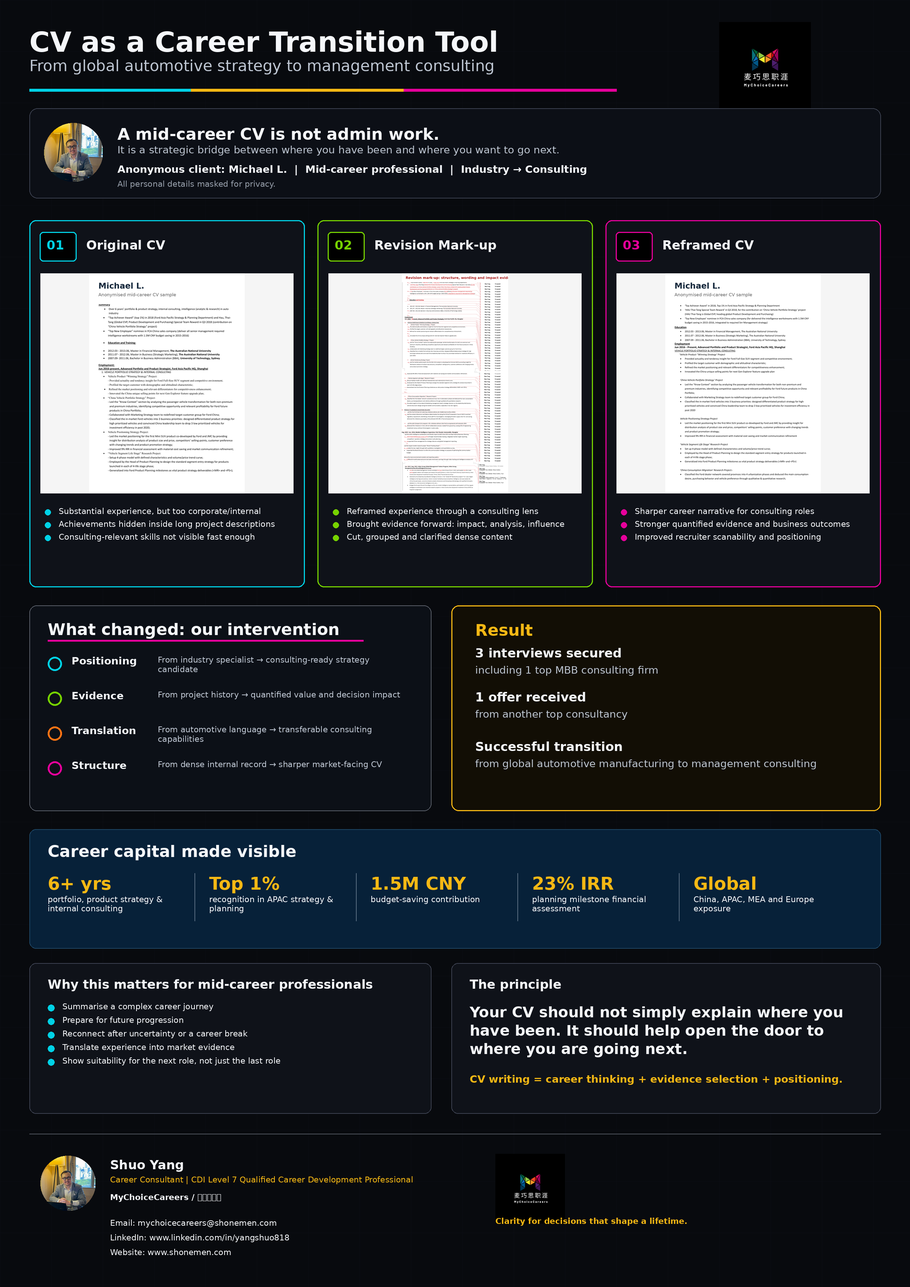
In this anonymised case, “Michael L.” had over six years of experience in the global automotive industry, with strengths across portfolio strategy, product planning, internal consulting, market intelligence and analytical research. His CV included significant achievements, including a top 1% internal recognition, a special team award for a major vehicle portfolio strategy project, and a cost-saving contribution of 1.5M CNY in an earlier role.
On paper, he was not lacking experience. The issue was different: his experience was too deeply embedded in the language of his original industry.
The CV was detailed, substantial and technically rich. It showed product strategy work, market research, business intelligence, customer segmentation, planning milestones, and regional strategy projects. But for a management consulting transition, the document needed to do more than describe responsibilities. It needed to translate industry experience into consulting-relevant evidence.
That is often the biggest challenge for mid-career professionals. They may have strong achievements, but the CV still reads like an internal corporate record rather than an external market-facing positioning document.
CV writing is not about making experience sound bigger
A common misunderstanding is that a CV writer simply makes someone “sound better”. That is not the point.
A good mid-career CV should not exaggerate. It should clarify.
It should help the reader see the logic of your career: where you started, what capabilities you developed, what types of problems you solved, and why those experiences make you credible for the next step.
In Michael’s case, the key was not to add more content. The CV already had a lot. The key was to reorganise and reframe the content so that consulting firms could quickly see relevant capabilities:
- strategic problem solving
- market and competitive analysis
- stakeholder influence
- portfolio and product strategy
- commercial impact
- structured thinking
- cross-regional business exposure
- leadership potential
For example, his revised CV brought forward consulting-relevant language such as “core capabilities in portfolio & product strategy, internal consulting and intelligence”, while also making achievements easier to scan: top 1% recognition, strategic project contribution, and quantified cost-saving evidence.
The shift: from job duties to transferable consulting evidence
One of the most important changes in a mid-career CV is moving from duties to evidence.
A duty says what you were responsible for. Evidence shows how you created value.
In the original CV, much of the experience was described through long project explanations. For example, the client had worked on vehicle portfolio strategy, customer profiling, market positioning and product planning projects in the automotive sector.
These were strong experiences, but for a consulting reader, the CV needed to answer sharper questions:
- What was the business problem?
- What analysis did you lead?
- What decision did your work influence?
- What measurable impact did it create?
- How transferable is this experience to client-facing consulting work?
The revised positioning made the evidence more visible. It highlighted work such as classifying vehicles into business priorities, influencing investment decisions, improving IRR through cost saving and market communication refinement, achieving 23% IRR in a planning milestone, and saving 22% of engineering investment in a co-engineered programme.
That is the difference between “I worked on strategy projects” and “I can solve structured commercial problems with measurable business impact.”
Why this matters for career transition
Many mid-career professionals reach a point where their next move is no longer obvious.
- Some want to move from industry into consulting.
- Some want to move from a technical role into leadership.
- Some want to return after a career break.
- Some feel they have done a lot, but their CV does not explain their value clearly.
- Some want to prepare for future progression before the market forces them to move.
In all of these situations, the CV becomes more than a job-search document. It becomes a tool for reconnecting the past with the future.
For a career transition, your CV needs to show continuity and change at the same time.
- Continuity means: “Here are the strengths I have built.”
- Change means: “Here is how those strengths apply to the next field, role or level.”
That bridge is where many mid-career CVs fail. They either stay too close to the old industry, or they become too generic and lose the depth that made the person valuable in the first place.
A mid-career CV should answer three questions
When I work on a mid-career CV, I usually think about three layers.
First: What is the person’s accumulated capital? This includes sector knowledge, technical skills, commercial exposure, leadership experience, stakeholder credibility, analytical ability, client experience and achievements.
Second: What is the next market asking for? A consulting firm, for example, may look for structured problem solving, analytical clarity, client-ready communication, business judgement, project leadership and measurable impact.
Third: How do we translate the first into the language of the second? This is where CV writing becomes career strategy.
For Michael, the career capital came from automotive strategy, product planning, intelligence and global exposure. His target market valued consulting-style problem solving, business impact, analytical depth and stakeholder influence. The CV therefore needed to connect these two worlds.
The outcome was not just a cleaner CV. It was a more convincing career narrative.
The result
After the CV transformation, the candidate secured three interviews, including one with a top MBB consulting firm, and received an offer from another top consultancy.
The lesson is not that a CV alone creates a career transition. It does not.
But a poorly positioned CV can hide your potential. A well-positioned CV can make your potential visible to the right audience.
CV writing as a life skill
My view is simple: a CV is a sales document, but not in a shallow or artificial way.
It is a paper-based introduction of your professional value. Its purpose is to show why you are suitable for a specific opportunity and to help you win the chance to be interviewed.
For mid-career professionals, this skill becomes even more important. Your career becomes more complex over time. You accumulate projects, achievements, detours, transitions, promotions, setbacks and sometimes career breaks. If you do not learn how to organise that story, others may misunderstand it.
Good CV writing helps you ask better questions:
- What do I want the reader to remember?
- Which achievements support my next step?
- Which details are no longer useful?
- What evidence proves my value?
- What future direction am I signalling?
That is why I do not see CV writing as an administrative task.
Done properly, it is a form of career thinking.
It helps you summarise your journey, prepare for progression, reconnect after uncertainty or a career break, and present yourself with clarity for the next opportunity.
Your CV should not simply explain where you have been. It should help open the door to where you are going next.
About Shuo Yang
Shuo Yang is a Career Consultant and CDI Level 7 qualified Career Development Professional. Through MyChoiceCareers, he supports students, graduates, families and mid-career professionals with CV strategy, career positioning, interview preparation and career decision-making.
MyChoiceCareers / 麦巧思职涯
Clarity for decisions that shape a lifetime.
- Email: [email protected]
- LinkedIn: www.linkedin.com/in/yangshuo818
- Website: www.shonemen.com
Write a comment